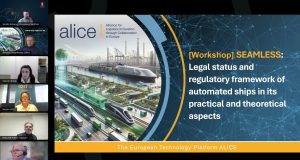
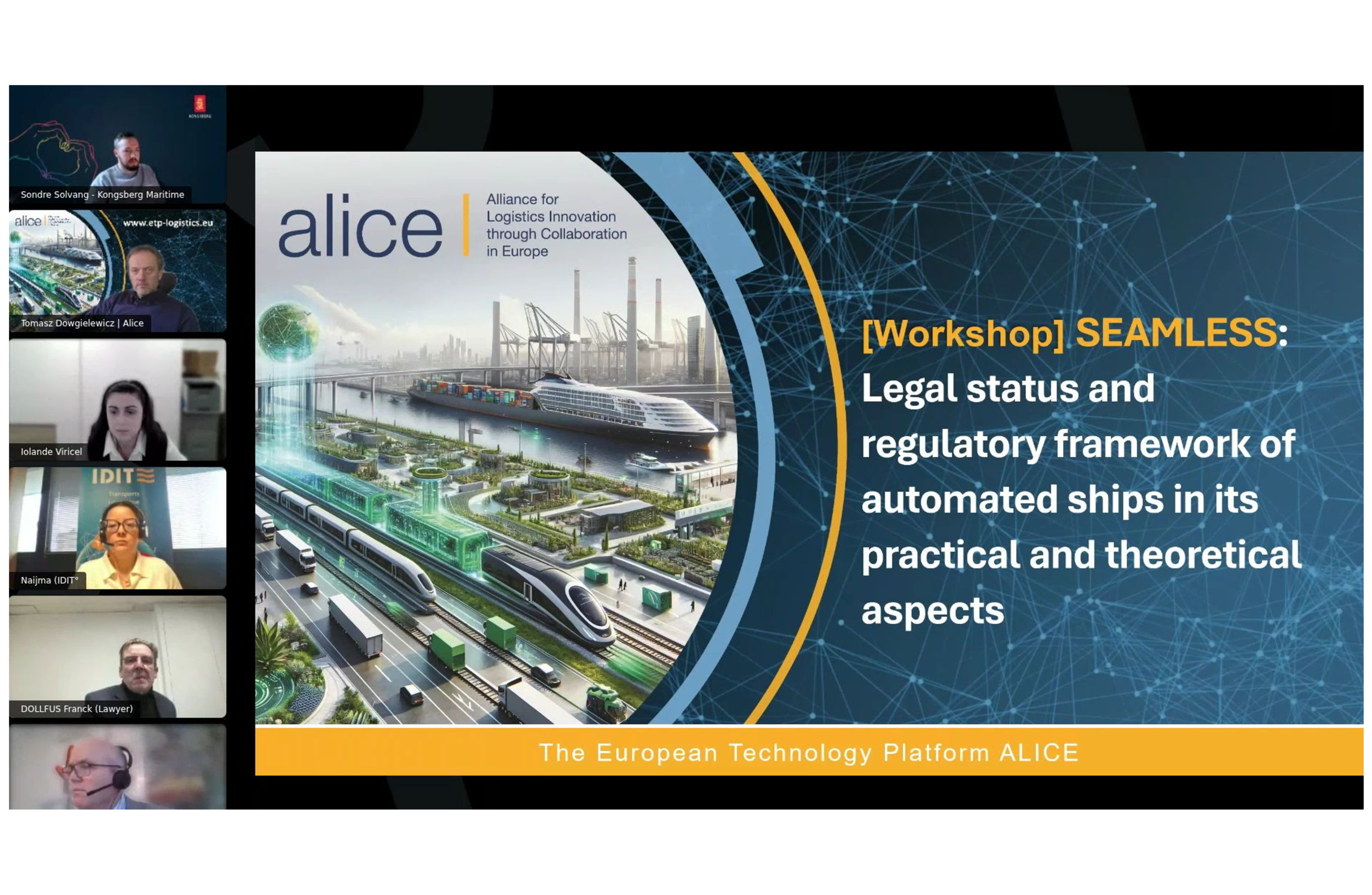
Key takeaways from the webinar SEAMLESS: Legal status and regulatory framework of automated ships in its practical and theoretical aspects
- 17/02/2026
SEAMLESS, in collaboration with ALICE, organised an online webinar dedicated to the legal status and regulatory framework of automated ships, bringing together around 40 participants from industry, research and public authorities. The session formed part of SEAMLESS’ broader technical webinar series addressing the key building blocks and enabling conditions for automated waterborne transport in Europe.
The webinar was opened and moderated by Tomasz Dowgielewicz (ALICE), who introduced SEAMLESS’ objectives and its ambition to facilitate a modal shift from road to waterways through economically viable and environmentally efficient autonomous feeder services. He positioned the discussion within the project’s wider efforts to tackle not only technological development, but also the regulatory and governance challenges linked to automation.
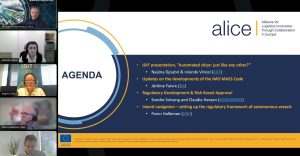
From a legal perspective, Naijma Djoubri and Iolande Viricel (IDIT) explored how automated vessels are currently qualified under international and national maritime law, questioning whether they can truly be considered “ships like any other.” Drawing on SEAMLESS use cases, they highlighted persisting uncertainties regarding seaworthiness, the role of the master, crew requirements, remote operations and the absence of a fully harmonised international framework.
Jérôme Faivre (Bureau Veritas) provided an update on regulatory developments at international level, presenting the ongoing work of the International Maritime Organization (IMO) on Maritime Autonomous Surface Ships (MASS). He outlined the roadmap of the IMO MASS Code, including key aspects related to responsibility, remote operations, risk-based approval and certification, and the expected transition from the current non-mandatory phase towards a mandatory framework in the early 2030s.
An industry perspective was offered by Sondre Solvang (Kongsberg Maritime), who illustrated how regulatory engagement and risk-based approval processes are applied in practice. Through concrete project examples, he demonstrated how collaboration with flag states and classification societies supports the approval and real-world deployment of autonomous and remotely operated vessels.
Finally, Fionn Halleman (Voies navigables de France – VNF) presented the inland waterway perspective, explaining the regulatory landscape for automated navigation in Europe. He described the role of the CCNR and CESNI in setting standards and enabling experimental operations, highlighting differences with the maritime framework and the challenges of cross-border navigation. The discussion underlined that inland automation is advancing primarily through pilot projects, with remotely operated vessels currently at the forefront.
The webinar concluded with an exchange on regulatory fragmentation, the transition from pilot projects to commercial operations, and the need for greater coherence across European frameworks. The discussion reaffirmed a key message of SEAMLESS: while technology is progressing rapidly, regulatory clarity, alignment and continued dialogue between regulators, industry and research are essential to enable safe, scalable and interoperable autonomous waterborne transport across Europe.