
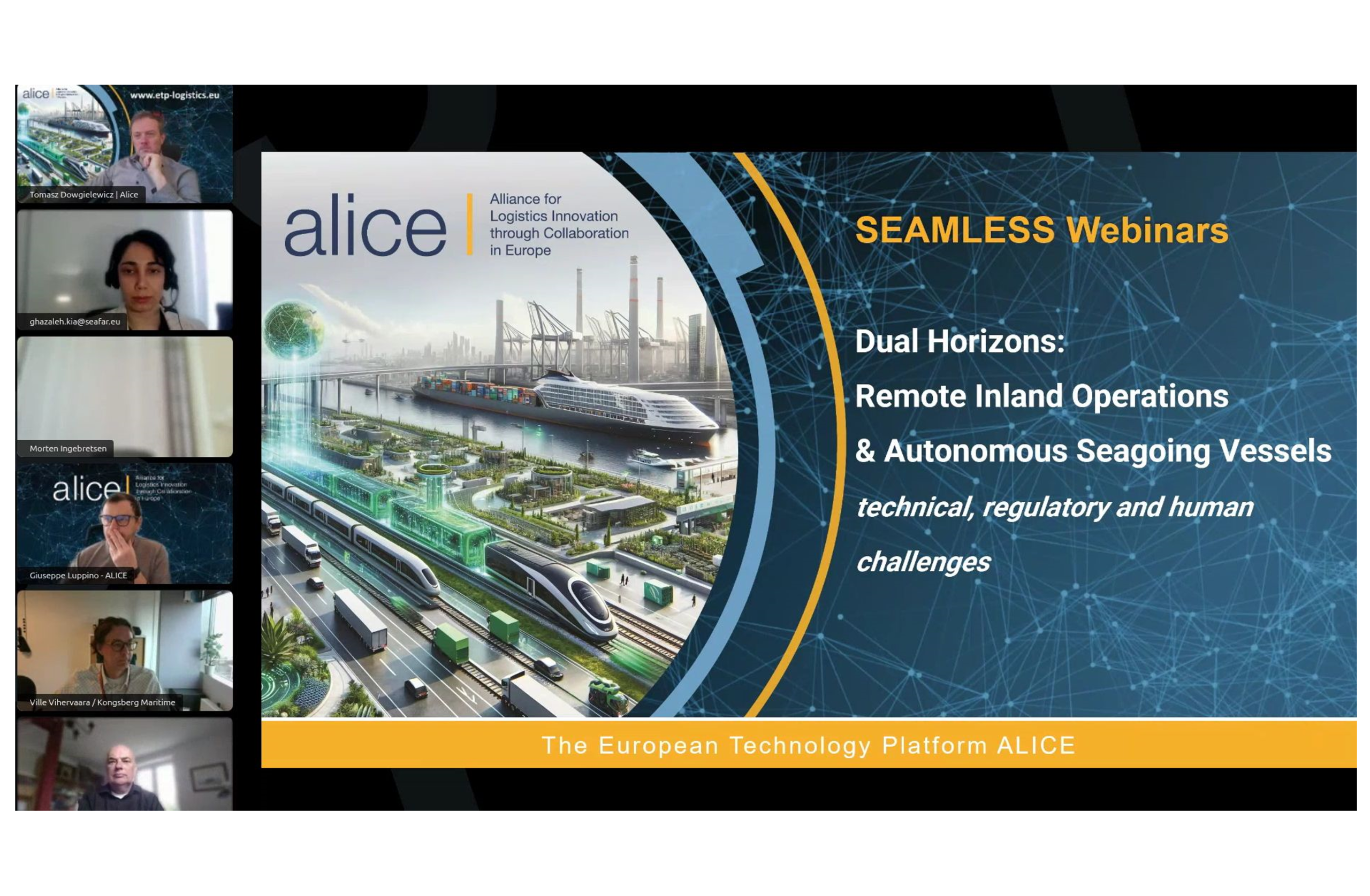
SEAMLESS Webinar Report: Dual Horizons – Remote Inland Operations & Autonomous Seagoing Vessels
- 23/04/2026
Remote vessel operations are often framed as a technological breakthrough. Yet, as highlighted during the SEAMLESS webinar organised by ALICE, technology is only one part of a much broader transformation. While systems for remote navigation, monitoring, and control are already mature, scaling these solutions beyond pilot projects requires equal progress in regulation, operations, and workforce adaptation.
The webinar explored what it takes to move from demonstration to real-world deployment. A central message emerged: scaling remote operations means scaling an entire operating model – from governance and regulatory alignment to integration within logistics chains and the development of new skills.
Opening the session, Tomasz Dowgielewicz (ALICE) positioned remote operations within the wider evolution of freight transport, emphasising that automation must be effectively embedded into real operational environments. He highlighted the need for regulatory adaptation, organisational readiness, and seamless integration with port and logistics ecosystems.
From an industry perspective, Ville Vihervaara (Kongsberg Maritime) outlined the gradual shift from onboard control to shore-based operations. While the technological building blocks are largely in place – including advanced sensors, connectivity, and control systems – the key challenge lies in integrating these elements into reliable, scalable solutions. Regulatory constraints and legacy frameworks remain a significant barrier to deployment.
Ghazaleh Kia and Nancy Scheijven (Seafar) provided practical insights from real-world operations, stressing that the main challenges are no longer technical, but systemic. They highlighted the importance of human factors, as remote operations require new skills, decision-making approaches, and organisational models. At the same time, they pointed to opportunities to improve working conditions and attract new talent to the sector.
The discussion reinforced the gap between technological readiness and large-scale adoption, underlining key issues such as business models, connectivity, cybersecurity, and integration into logistics chains.
The webinar concluded that remote vessel operations are no longer a future vision, but an emerging reality. However, their widespread deployment will depend on aligning technology with regulation, operations, and people. As the sector evolves, remote operation centres are set to become a cornerstone of more efficient, resilient, and sustainable transport systems.